
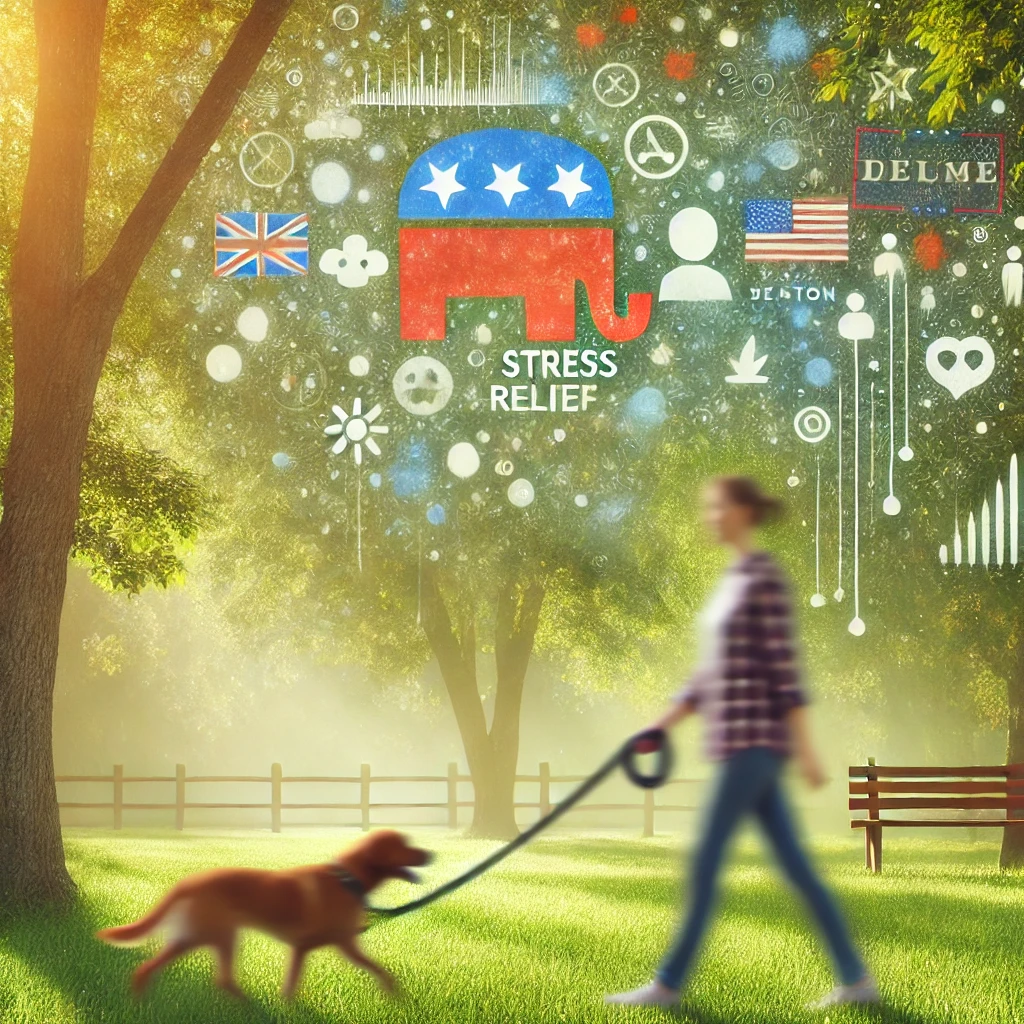
5 Proven Strategies to Cope With Election Anxiety
The looming Presidential election can be an emotional minefield. Here’s how to protect your mental health during elections.
Key Takeaways:
- Coping with election anxiety can be rough: Approximately one in three American adult social media users admit to doomscrolling, with higher rates among Millennials (46%) and Gen-Z (53%).
- Implementing a strict “news diet” by limiting exposure to election coverage and politics to specific times of the day can help maintain mental health.
- Re-framing how you discuss politics by using phrases like “I’ve been thinking about…” or “What’s your perspective on…” can create more productive dialogues and reduce emotional charge.
- Adopting a pet can provide emotional support and shift focus away from political stress.
- Daily walks release endorphin and act as a mood-booster.
- Cognitive-behavioral therapy (CBT) can be effective in managing election-related anxiety.
The looming November showdown isn’t just another date on the calendar—it’s an emotional minefield waiting to explode.
Everywhere we turn, election narratives dominate our attention.
The relentless 24/7 news cycle and social media echo chambers bombard us with alarmist messages: “Candidate X Will Obliterate Everything You Hold Dear!”
It’s an inescapable reality that can ambush your peace of mind at any moment, threatening to plunge you into a vortex of anxiety and despair.
Are you already feeling the strain?
Chances are, you’re not alone. According to Morning Consult, approximately one in three American adult social media users admit to doomscrolling—endlessly consuming negative news content. Millennials and Gen Z are hit hardest, with 46% and 53%, respectively, acknowledging chronic doomscrolling habits.
This constant barrage of doom and gloom can shake even the most resilient news consumers to their core, potentially triggering severe anxiety or, in extreme cases, full-blown depression. It can even tear families apart.
So, how do you protect mental health during elections?
As arguably the most heated and divisive election in history unfolds, how can you protect your mental health?
The Bottom Line: you need effective mental health strategies.
Here are five powerful strategies to shield your mental health from election stress:
Election Stress and Mental Health Tips:
Go On a News ‘Diet’
First and foremost, recognize this: Your mental health takes precedence over political engagement. Period.
While staying informed is important, it shouldn’t come at the expense of your emotional well-being.
Traditional television news has become increasingly partisan over the past decade, but this trend started long ago. Before the 1920s, most news outlets were openly biased. Objectivity became the norm only when newspapers merged and needed to appeal to a broader audience without alienating readers.
In the 1940s and ’50s, news was almost entirely “just the facts” without much context, making it easy for demagogues to exploit. After the fall of the Fairness Doctrine—which required media to report facts corresponding to all political viewpoints—the news fast-tracked back to the partisanship of a century ago.
Turn on a cable news network today, and you’re likely stepping into an echo chamber designed to engage a specific subset of viewers.
But “news” isn’t confined to TV networks, radio programs, or dedicated websites anymore. Raw commentary, opinions, and unfiltered sources flood social media. A late-2023 Pew Research Center study estimates 53% of X (formerly Twitter) users and 43% of TikTok and Facebook users get their news from these platforms. Even Instagram, known more for glamour than discourse, has 34% of its users digesting news.
Why is this a problem? Misinformation.
The sheer volume of news and political commentary makes it impossible to fact-check everything. Dangerously misleading posts often garner millions of views before they’re flagged or taken down—if that happens at all.
So what can you do? Consider implementing a strict “news diet,” limiting your exposure to election coverage and politics to specific times of the day. This way, you stay informed without being constantly bombarded by potentially distressing and biased information.
Remember, it’s perfectly acceptable—and often necessary—to step back and focus on self-care during these tumultuous times.
Election Stress and Mental Health Tips:
Re-frame How You Talk About Politics
Once you step back from consuming online and traditional news, you might notice a change in how you talk about and engage with politics.
In today’s all-or-nothing political climate, we often make our opinions known via social media. Even by simply “liking” or sharing content, we tell the world who we are. Each time we engage online, we embed our identity alongside our posts.
The more you do this, the more your identity becomes entwined with your political beliefs.
That’s why you may take dissenting political comments personally. It’s not just a friend stating their own viewpoint; it feels like an attack on your worldview—your ego.
This mindset also makes it difficult to speak your mind for fear of rejection from your social circle or family. Social rejection isn’t just emotionally distressing; it can cause physical pain, activating the same areas of the brain associated with physical discomfort.
Alternatively, you might face strong social pressure to conform your views, leading to cognitive dissonance.
To navigate these challenges, try reframing how you discuss politics.
Instead of presenting your views as absolute truths, approach conversations with curiosity and openness.
Use phrases like “I’ve been thinking about…” or “What’s your perspective on…” to create a dialogue rather than a debate.
This approach not only reduces the emotional charge of political discussions but also allows for more nuanced and productive conversations, potentially leading to greater understanding between differing viewpoints.
Election Stress and Mental Health Tips:
Adopt a Pet
In the midst of political chaos and the relentless churn of the news cycle, sometimes the best antidote is a four-legged friend.
Adopting a pet isn’t just about giving an animal a home; it’s about enriching your life with unconditional love and companionship that can serve as a buffer against stress and anxiety.
Pets have a remarkable ability to ground us in the present moment. The simple act of stroking your dog’s fur or listening to your cat’s purr can release oxytocin—a hormone associated with bonding and stress relief. According to a study published in the Journal of Behavioral Medicine, interacting with pets can lead to significant reductions in cortisol levels, the body’s primary stress hormone.
But before you rush to the nearest animal shelter, consider the responsibilities that come with pet ownership. Owning a pet requires time, financial resources, and emotional investment. It’s a commitment that should not be taken lightly. However, if you’re ready to take the plunge, the rewards can be immeasurable.
Not only do pets provide emotional support, but they also introduce structure and routine into your life. Feeding times, walks, and play sessions become anchors in your day, offering a welcome distraction from the incessant barrage of political news. In a way, your pet becomes a microcosm of positivity in a world that often feels overwhelmingly negative.
Election Stress and Mental Health Tips:
Go on Daily Walks
Physical activity is a well-documented stress reducer, but you don’t have to be a marathon runner to reap the benefits. Incorporating daily walks into your routine can serve as a powerful countermeasure to election-induced anxiety. The beauty of walking lies in its simplicity and accessibility; all you need is a pair of comfortable shoes and a safe path to tread.
When you engage in moderate physical activity like walking, your body releases endorphins—natural mood elevators that can help alleviate feelings of stress and depression. A report from the American Psychological Association highlights that even a 20-minute walk can significantly boost your mood and increase overall mental well-being.
Moreover, walking offers an opportunity to unplug from the digital noise. Leave your phone at home or set it to airplane mode. Use this time to observe your surroundings, breathe in the fresh air, and perhaps even practice mindfulness. Notice the rustling of leaves, the warmth of the sun on your skin, or the rhythm of your footsteps. This intentional focus on the present moment can help break the cycle of anxious thoughts about the future.
For added benefit, consider walking in green spaces like parks or nature trails. Studies have shown that exposure to nature can enhance the stress-reducing effects of physical activity. If you’ve adopted a pet, as mentioned earlier, bringing them along can make your walks even more enjoyable and fulfilling.
Election Stress and Mental Health Tips:
See a Professional
Sometimes, self-care practices aren’t enough to combat the overwhelming stress that comes with highly charged political climates. If you find yourself constantly on edge, losing sleep, or unable to focus on daily tasks, it could be time to consult a mental health professional.
Therapy isn’t just for those in crisis; it’s a proactive step toward maintaining your mental well-being. Cognitive Behavioral Therapy (CBT), for example, is particularly effective in helping individuals manage anxiety by changing negative thought patterns. A licensed therapist can provide personalized strategies to cope with stressors specific to your life.
It’s also worth noting that seeking professional help is a sign of strength, not weakness. In a culture that often glorifies self-reliance, recognizing when you need support is crucial. According to the National Alliance on Mental Illness, one in five adults experiences mental illness in a given year, yet many do not seek treatment due to stigma or misconceptions about therapy.
In addition to traditional therapy, consider exploring support groups or workshops focused on stress management. These can provide communal support and practical tools to help with coping with election anxiety. Remember, investing in your mental health is as important as any other aspect of your well-being.