
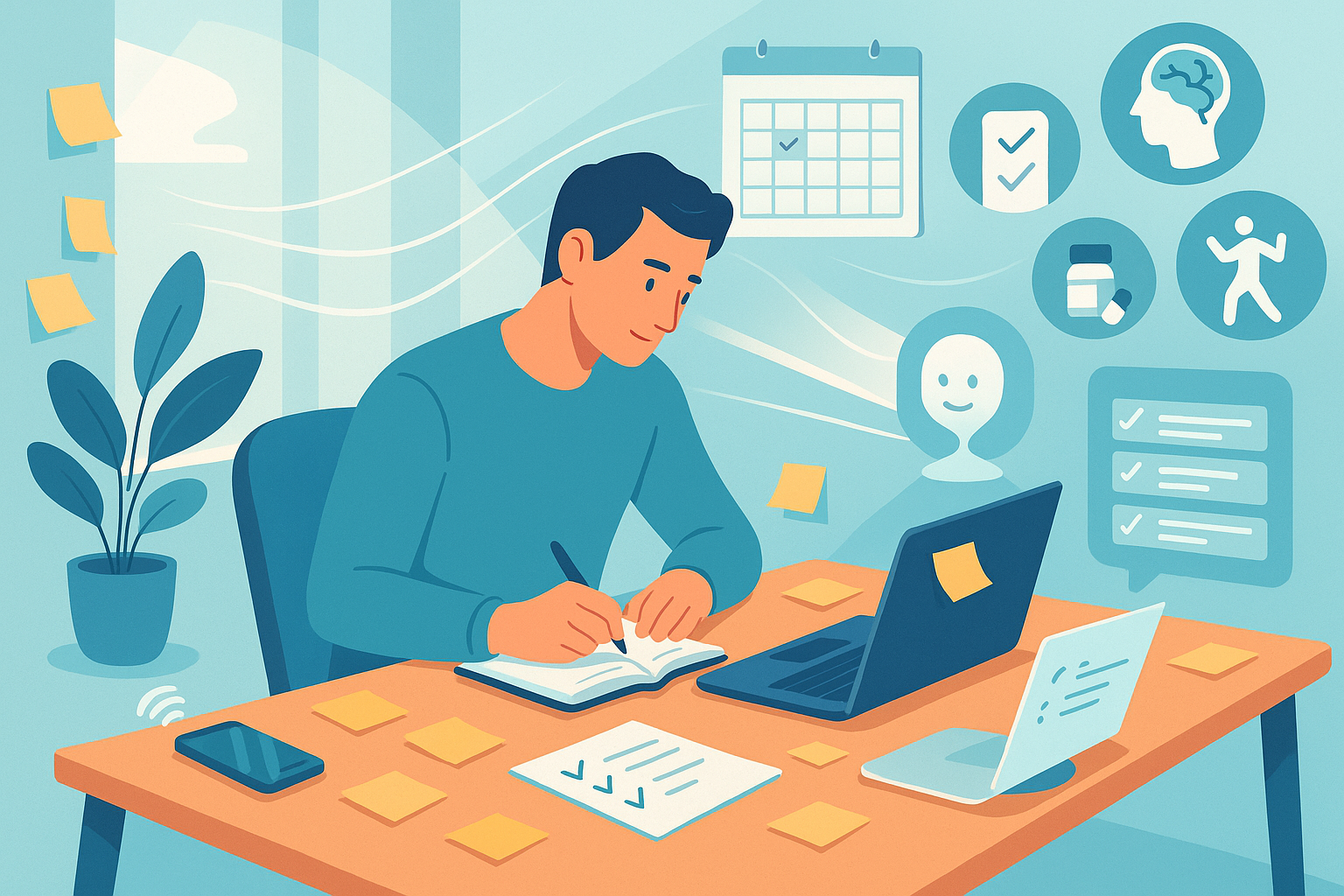
A diagnosis of attention-deficit/hyperactivity disorder (ADHD) in adulthood can feel clarifying – and overwhelming.
Adult ADHD could explain why your focus slips at the worst moments, why deadlines creep up despite your best efforts to stay ahead, and why basic administrative tasks balloon into week‑long stress. But identifying ADHD as an adult is only a starting point…
ADHD affects how the brain regulates attention and inhibition and how you plan, prioritize, and follow through. The good news: multiple treatments help, and outcomes are best when therapy, medication, and daily systems work together.
How ADHD Shows Up at Work and Home
- Focus challenges aren’t just “distraction.” Adults often swing between difficulty sustaining attention on routine tasks and periods of hyperfocus on engaging ones.
- Impulsivity can look like speaking before thinking, quick spending decisions, clicking “send” too soon, or jumping between tasks.
- Executive dysfunction – trouble with working memory, planning, initiation, time management, and self‑monitoring – often drives the day‑to‑day disability (missed emails, late starts, half‑finished projects). Research consistently links adult ADHD with executive‑function deficits, even when intelligence and motivation are intact.
Therapy Approaches That Move the Needle
- CBT for ADHD. Structured cognitive‑behavioral therapy targets “thinking traps” (“I always blow it”) and builds concrete skills: breaking projects into steps, scheduling, cueing, and coping with setbacks. Trials in adults show CBT reduces residual symptoms and improves quality of life, especially when layered on medication. Component reviews highlight that skills practice, homework, and problem‑solving modules matter.
- ADHD‑focused coaching. Coaching is practical and forward‑looking: clarify goals, design weekly routines, and set up accountability (e.g., “body‑doubling” sessions where you work alongside someone – virtually or in person – to reduce friction).
- Psychoeducation & support. Understanding your pattern reduces shame and helps you explain needs to colleagues and family. Many adults do best with a blended plan: skills training plus targeted psychotherapy for mood or anxiety if present. The NIMH notes that effective adult care often combines medication with psychotherapy.
Medication Considerations (Talk With Your Prescriber)
For many adults, stimulants are first‑line because they have the strongest evidence for improving core symptoms. U.K. NICE guidance recommends lisdexamfetamine or methylphenidate as initial options in adults whose symptoms continue to cause significant impairment after environmental adjustments. Finding the right dose and formulation is individual; expect careful titration and monitoring for side effects (e.g., appetite change, insomnia, blood pressure/heart rate).
If stimulants aren’t suitable or tolerated, non‑stimulants such as atomoxetine (and, in some regions, guanfacine or clonidine) are alternatives. Comparative reviews in adults continue to find stimulants and atomoxetine effective for symptom reduction, while calling for more long‑term and head‑to‑head data. Whatever the choice, combine medication with skill‑building to translate symptom relief into reliable routines.
Practical safety notes: Store medications securely; avoid doubling doses to “catch up”; discuss interactions (including caffeine and alcohol); and tell your clinician about your cardiovascular history or sleep problems. If access to medication is inconsistent, prioritize non‑pharmacologic scaffolds (below) so your system doesn’t collapse during gaps.
Everyday Strategies to Regain Control (Especially for Busy Professionals)
Design your day, not just your to‑do list
- Pick three must‑do outcomes for the day; park everything else on a “parking lot” list.
- Time‑block those outcomes on your calendar with alarms; protect them like meetings.
- Start with a 90‑second “launch ritual” (open agenda, clear desk, start timer) to reduce initiation friction.
- AI assist: Ask a planning assistant to convert your three outcomes into calendar blocks with prep and buffer time.
- Prompt: “You are my scheduling assistant. I have these three priorities today: A, B, C. Create a realistic calendar with start times, 10‑minute buffers, and a 15‑minute review at day’s end.”
Work the task, not the guilt
- Break deliverables into micro‑steps that fit 10–25‑minute sprints; use a simple timer.
- Apply a 2‑minute rule: if a step can be finished in two minutes, do it now; otherwise schedule it.
- AI assist: Use a chatbot to chunk a vague goal into a checklist of micro‑steps sized for a 20‑minute sprint and to generate the first “starter step” so you can begin immediately.
- Prompt: “Turn ‘draft Q3 strategy memo’ into 6–8 steps I can do in 20‑minute sprints. Bold the very first 2‑minute starter action.”
Tame email and meetings
- Process email in two or three windows per day; turn off notifications otherwise.
- Use a four‑D triage: delete, delegate, defer (schedule), do.
- Ask for agendas in advance; take notes with a “Next Actions / Waiting For” footer to capture commitments before the meeting ends.
- AI assist for meetings: AI note‑taking apps—e.g., Reflect Notes (reflect.app)—can transcribe your meetings so you can stay present rather than multitask. Afterward, prompt the tool to produce an executive‑style summary with action items, owners, and deadlines.
- Prompt: “From this transcript, create a 7‑bullet executive summary, then list action items with owner, due date, and the next concrete step. Flag any unclear assignments.”
- Prompt: “From this transcript, create a 7‑bullet executive summary, then list action items with owner, due date, and the next concrete step. Flag any unclear assignments.”
- AI assist for email: Use AI to summarize long threads, extract tasks into your task manager, and draft replies—then schedule‑send so you can review with a calm brain before it goes out.
Reduce spending impulsivity with space
- Build a 30‑second pause before replies or purchases; draft, then re‑read once.
- For non‑urgent buys, use a 24‑hour hold list.
- AI assist: Ask a chatbot to act as a cool‑off coach: generate a pros/cons list, total cost of ownership, and a 24‑hour follow‑up reminder.
- Prompt: “I want to buy X. Challenge my reasoning, estimate true costs over 12 months, and suggest a cheaper or slower alternative. End with a 24‑hour check‑in plan.”
Externalize memory
- Keep one trusted capture system (notes app + calendar). Everything goes there – no sticky notes on five different surfaces.
- AI assist: Use AI to auto‑tag and link notes, create “Waiting For” trackers from meeting summaries, and set smart reminders (e.g., “If we mention Client Y, add it to the Client Y dossier and schedule a 10‑minute follow‑up tomorrow morning”).
- Prompt: “Scan these notes and extract tasks, deadlines, and ‘waiting for’ items. Merge into my single task list with due dates.”
Energy management is time management
- Short bouts of physical activity (even 10–20 minutes) can lift mood and attention; emerging adult data and broader reviews support exercise as a helpful adjunct while researchers refine the “what kind” and “how much.” (PLOS, Frontiers)
- Protect sleep regularity, hydrate, and front‑load protein in the morning to smooth energy and reduce mid‑day crashes.
- AI assist: Ask for a custom micro‑routine tied to your calendar (e.g., “Between 2:00–2:10 pm suggest a desk stretch; at 4:30 pm prompt a 5‑minute shutdown ritual”). Use an assistant to generate meal and snack plans that fit your day’s workload and energy dips.
Ethical guardrails for using AI with ADHD
- Consent & policy: Get explicit consent before recording or transcribing meetings; check employer and client policies.
- Privacy: Prefer tools that offer encryption, data‑retention controls, and opt‑out from model training. Avoid pasting sensitive client or personal health data into general chat tools.
- Accuracy: Treat outputs as drafts, not facts – especially for dates, numbers, or commitments. Verify before sending.
- Transparency: If AI helped draft or summarize, you can say so (“Drafted with AI, reviewed by me”).
- Boundaries: Don’t let tools multiply tasks. Choose one capture system, one calendar, and a small set of automations that genuinely reduce friction.
Used this way, AI becomes scaffolding – not a crutch – so you can focus on high‑value work, safeguard privacy, and translate intention into action.
Putting It Together
You don’t have to simply grin and bear your ADHD in adulthood – you can reclaim your brain again. The pathway to becoming your best self isn’t a narrow one. Rather, you must think in layers:
- Start with some small environmental tweaks that make the right action the easy action.
- Seek skill‑based therapy (CBT/coaching) to build reliable habits and use medication when indicated to reduce symptoms enough that skills can stick.
- Leverage AI to simplify complex tasks, streamline meetings, and conserve your time.
Adult ADHD is more common than you probably know, but it’s also more treatable than most believe. Combining approaches is often the fastest way to feel in control again. If you’re starting from scratch, a conversation with a clinician about therapy plus medication options – and what to try first in your context – is a strong next step.